Sees the real work
Observes how work is actually performed across web, desktop, legacy and office applications — not only what the systems recorded.

Case by case and end to end — then turned into a number your Finance team will defend, in thirty days.
Observes how work is actually performed across web, desktop, legacy and office applications — not only what the systems recorded.
Connects every activity to business data and to your own cases, then rebuilds end-to-end paths, variants and handoffs.
No-install recording with non-intrusive desktop-recording software, no Administrator-level endpoint access, and no log extraction before the first evidence.
AI recognizes, a process engineer approves, reconstruction is deterministic — then the result is translated into hours and dollars.
Not a vendor scorecard. Four categories of approach, and the question each one is able to answer.
| Approach | What it shows you |
|---|---|
| Workshops and interviews | How people describe the work. |
| Event-log process mining | What the systems recorded. |
| Application usage | Where the time went. |
| A general-purpose AI assistant | What you were able to describe to it, and what it could read from a screen recording. |
| Stereologic | The work actually done — by case, end to end. |
A fair question, and worth answering properly rather than dismissing. A general-purpose assistant is genuinely good at summarising what it is given. The work is in getting it something worth summarising.
To use one for operational discovery, somebody first has to produce the raw material: design and run screen recording across many desktops over many days, then collect, store and review it. That is a project before it is an analysis, and it carries its own privacy and security conversation.
Then the hard part starts. The assistant sees pixels and prose. Turning that into something an operation can act on means getting it to reliably name which application and which screen the work happened on — and in most business systems several screens share one window title, so the title alone will not tell you. It means reading the business data on those screens and the values inside it. It means telling a real process step apart from navigation between screens. It means reconnecting a task that was interrupted on Tuesday and finished on Thursday, and separating two tasks worked in parallel. It means tying all of it to the case it belongs to. Each of those is a sustained prompt-engineering effort, and each one has to produce the same answer every time, or the number built on top of it cannot be defended.
Stereologic uses AI for exactly this recognition work — applications and screens, detailed activities, business data and its values, case identity, decision branches. A process engineer reviews, corrects and approves those outputs at defined checkpoints. Everything downstream — case assembly, end-to-end reconstruction, map generation — is deterministic, so the same recorded work produces the same model every time. It is the product of eighteen years of operational discovery and three granted U.S. patents, not a prompt.
Where an assistant earns its place is after that: asking questions of evidence that has already been recognised, reviewed and assembled. That is a good use of it. It is not a substitute for producing the evidence.
A task looks simple in the workshop. The real operation around it is not. Between the start and the finish sit interruptions, other cases, email, spreadsheets, waiting, handoffs, returns and corrections.
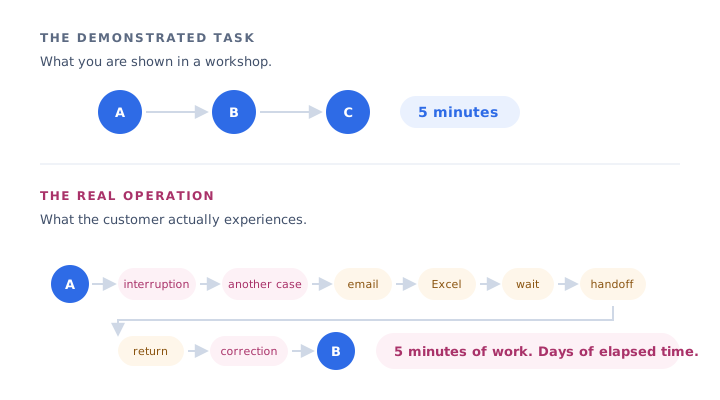
Workshops see the demonstrated task. System logs see the transaction. Neither sees the week. Stereologic measures the work in between.
Illustrative claims-processing example. The same three hours and fifty-two minutes, read two ways.
This shows where time was spent.
This shows what work was actually accomplished.
Stereologic connects that task-level understanding with the end-to-end process — cases, flows, handoffs, variants and outcomes. What work was actually done, and what business outcome followed.
Illustrative example for explanation. Not an actual client result.
Non-intrusive, no-install desktop-recording software. No Administrator-level endpoint access.
Evidence collection does not wait on system integration or log extraction.
Processing stays within the approved deployment environment.
On-premises, client cloud or dedicated hosted.
Independently audited controls. Report available under NDA.
One agreed scope, thirty days, a named owner on both sides.
Bring us one operation where cost, capacity, service or transformation is under pressure. One scope, agreed in writing, thirty days to a measured baseline and an executive readout.