No data-log preparation
Discovery runs against the process as it is performed today, rather than after months of log extraction, cleansing and reconciliation.

See how work moves across systems, teams and process variants as it is actually performed — with no data-log preparation and no source-system integration to begin, and including the manual, cross-application work that never reaches an event log.
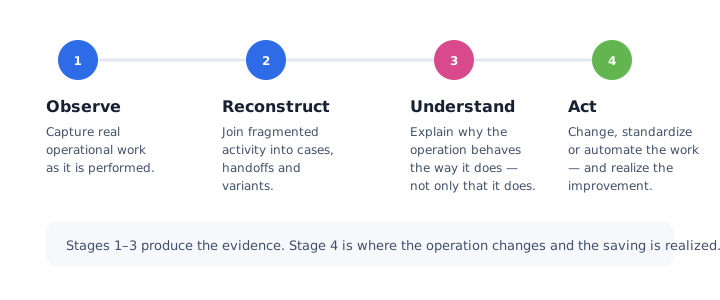
Where discovery sits in the wider operating model.
The difference that matters operationally is when you get a result. Stereologic discovers end-to-end processes, including time and frequency, without waiting for database logs to be prepared — and it works in systems that keep no usable logs at all.
Discovery runs against the process as it is performed today, rather than after months of log extraction, cleansing and reconciliation.
You do not need a connector or an ETL build before the first evidence arrives, which is usually what delays a first result.
Excel and Outlook work, desktop clients, mainframe screens and one-of-a-kind custom applications are all in scope, whether or not they write to a database.
Stereologic’s patented approach reads the screens and interactions of the work itself — computer vision and semantic screen recognition applied to what people actually see and do — so discovery does not depend on what a system chose to log. The technology has been in continuous development since 2008.
Instead of interviewing people and drawing the process by hand, Stereologic observes many people at work across their own applications and generates the end-to-end view — across sites, platforms and office tools.
Work performed by distributed teams on many different platforms is captured and visualized as one end-to-end process, including the variants that were never documented.
For each activity you see how many times it ran and how long it took, alongside processes performed per employee, average time per process, the frequency of each scenario and time spent per client.
Two discovered processes can be compared step by step with common and dissimilar activities highlighted — how teams and lines of business actually differ, and why some cases take longer.
The discovered model is hierarchical. Drill from a process into sub-processes, activities, micro-activities and the actual screens, so a delay can be tied to the step and the system that produced it.
Transactional records are real evidence, and Stereologic uses them. They are not the whole picture: the manual, cross-application and undocumented work between transactions is where cycle time is usually decided, and it rarely reaches a log in usable form. Process Mining connects both.
Re-keying, lookups, spreadsheet steps, email approvals and the workarounds that keep cases moving.
The paths people take when the documented process does not fit the case in front of them.
Observation runs with non-intrusive, no-install desktop-recording software and no Administrator-level endpoint access, on premises or in an approved cloud environment.
Discovery output is meant to be handed to the people doing the change work — process, transformation, automation and implementation teams.
Medicare claims processing
No. Discovery observes the work as it is performed, so it does not depend on a log-extraction or data-preparation project. Systems that keep no usable logs — spreadsheets, mailboxes, desktop clients and legacy applications — are still in scope.
Not to begin discovery. There is no connector build or ETL project standing between you and the first evidence. Integration can follow later if a specific system’s data is needed.
No. Work is observed with non-intrusive, no-install desktop-recording software and no Administrator-level endpoint access. Deployment options, data handling and the security evidence available for review are set out on the Security & Deployment page.
Process Mining answers where the work goes: how it moves end to end across systems, teams and variants. Deep Task Mining answers what work was accomplished inside the applications. Process Intelligence integrates the two. They are capabilities of one platform, not competing products.
Pick a process you are being asked to improve, automate or defend. Stereologic can reconstruct how it really runs, measure it activity by activity, and give your team a baseline they can stand behind.