Process Mining
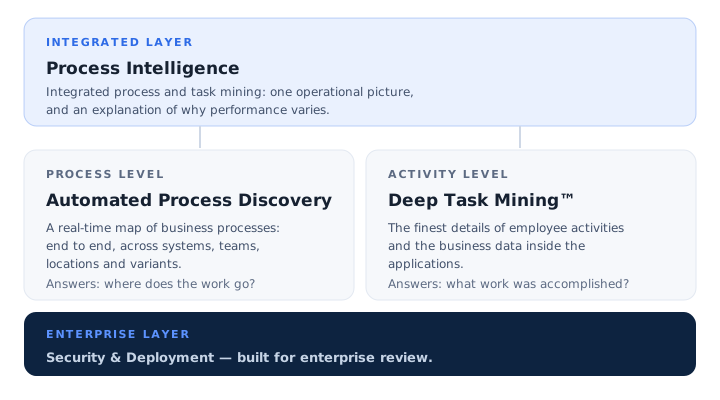
A real-time map of business processes. How work actually runs end to end, across systems, teams, locations and variants — built from observed work rather than from a log-extraction project.
Answers: where does the work actually go?

Stereologic observes operational work across and inside applications, tasks and teams as it happens, and reconstructs it into a live, measurable model of how your operation works, why it behaves that way, and where change will create value.
Process-level evidence and detailed employee activity are not competing views of the same problem. They answer different questions, and Process Intelligence is where process mining and task mining are brought together into one model.
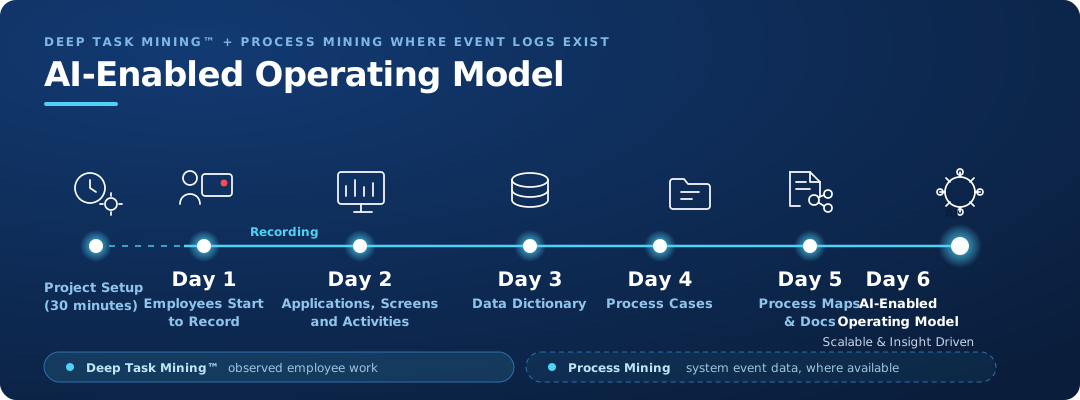
Deep Task Mining™ and, where event logs exist, Process Mining create the AI-Enabled Operating Model.
A real-time map of business processes. How work actually runs end to end, across systems, teams, locations and variants — built from observed work rather than from a log-extraction project.
Answers: where does the work actually go?
The finest details of employee activities and data. Not only which application was open and for how long, but what was being done inside it, to which business data, and against which case.
Answers: what work was actually accomplished?
Integrated process and task mining. The two levels combined into one operational picture, and measured: timing, frequency, variation, bottlenecks, rework, productivity differences and root causes. This is the layer that explains why the operation performs the way it does, rather than reporting that it does.
Answers: why does performance vary, and what is it costing?
Built for enterprise review. On-premises or within an approved hosted or cloud environment, with non-intrusive desktop-recording software and processing kept inside the agreed environment. Explore Security & Deployment.
Deep Task Mining™ builds it. Where event logs exist and are usable, Process Mining extends it. The capabilities are not the point. This is: a working model of the operation, built from observed work — extended by system event data where that data is available — that the business keeps using after the engagement ends.
The platform describes what the capabilities are. This describes how the evidence progresses — and where it has to end up if the exercise is going to be worth anything.
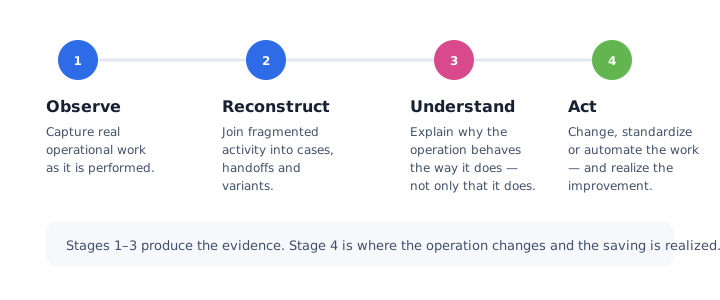
Capture work occurring across applications — including email, spreadsheets, desktop, legacy and custom environments — with non-intrusive, no-install desktop-recording software and no Administrator-level endpoint access, and without a source-system integration standing in front of the first evidence.
Connect activity across people, applications, interruptions, variations and handoffs into cases and end-to-end processes. Where a client-defined case identifier is available, that assembly is deterministic: the same recorded work produces the same model.
Measure timing, frequency, effort, variation, bottlenecks, rework and productivity differences — and explain the causes behind them. This is the layer that separates “something is inefficient” from “here is why it is inefficient.”
Change the process, standardize it, remove unnecessary work, redesign it or automate it — then measure the operation again to confirm the improvement was realized. Process maps, SOPs, requirements and a measured baseline are the inputs to that change, not the end of the exercise.
Knowing that somebody spent half a day inside a claims application does not tell you whether they processed forty claims or one, approved or rejected them, got stuck, or accomplished anything useful at all. Deep Task Mining connects application activity to the business work being done.
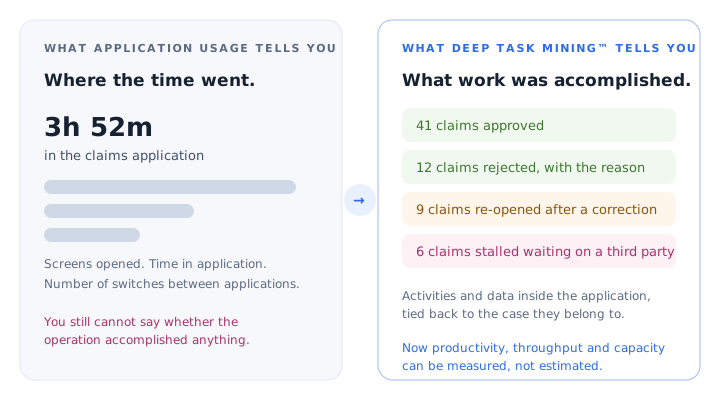
System and process evidence, human activity, business activity inside applications, and the handoffs and interruptions between them add up to a more complete view of the operation than any one of them alone.
See how deployment and data handling work
Compare this architecture with Celonis, Skan.ai, Mimica and Apromore
Back-office customer management operations at Pitney Bowes. Figures are drawn from Stereologic’s published Pitney Bowes case study. Read the full story and method.
Bring one operational scope and one number you are being asked to defend. We will show how that work can be observed, reconstructed and measured — before you decide what to improve, automate or transform.
Not ready to meet? See Customer Results