Pitney Bowes
- 56%Customer-service acceleration
- 20% → 0%Errors in servicing customers
Back-office customer management. Results achieved in under 90 days. Winner, 2014 Process Excellence Award for Best Process Improvement Project under 90 days.

Service-level problems are usually blamed on effort or headcount. The measurement almost always shows something else: the work itself takes minutes, and the customer waits days. Stereologic separates active work from elapsed time, finds where the errors and the delay are created, and attributes both to specific steps.
A service level is a promise about elapsed time. Most operational measurement reports active time, which is a different number and usually a much smaller one. When the two are not separated, the improvement programme optimizes the five minutes and the customer still waits the week.
Errors behave the same way. A rework loop rarely shows up as a failure in a system record — it shows up as a case that was touched again, by someone else, later. Unless the case is reconstructed end to end, the cost of getting it wrong the first time stays invisible and the service-level conversation stays anecdotal.
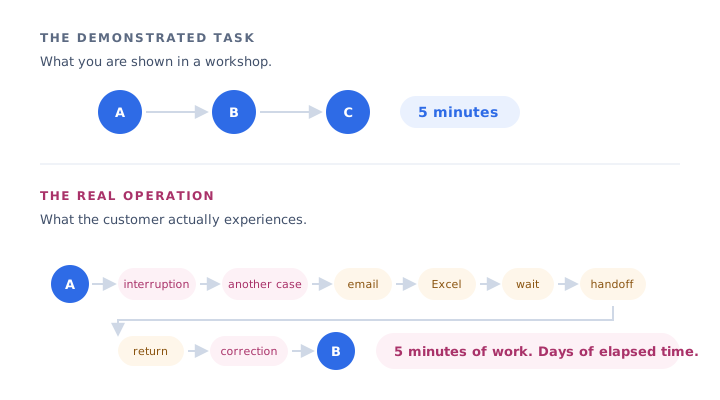
Each of these is measured from observed work and attributed to a specific activity, not to a department.
Why it matters to the business. A service level you can attribute is a service level you can fix. Once delay and error are traced to specific activities, the improvement can be targeted and the result measured afterwards against the same baseline.
Back-office customer management. Results achieved in under 90 days. Winner, 2014 Process Excellence Award for Best Process Improvement Project under 90 days.
Loan-origination platform stabilization across the branch network. Diagnosed and resolved in under six months. Bank not named at its own request.
Most service reporting states what the elapsed time was. It rarely explains what created it, because the waiting, the handoffs and the rework happen between system records rather than inside them. Stereologic reconstructs the case end to end, so elapsed time is attributed to specific activities and specific waits.
The unit of analysis is the process and the case, not the person. Findings are reported at the level of activities, steps, teams and variants.
Yes. Waiting on a third party, a customer or an upstream team is measured separately from work inside your own operation, so the service-level conversation distinguishes what is addressable from what is not.
Tell us the promise you make to customers and where it is being missed. We will show how that work can be observed, reconstructed and measured — and what it would take to explain the gap.