Case assembly
Approved recognition outputs are associated to your own case identifier and assembled into complete case traces.

“AI-powered” tells an evaluator nothing. This page names the specific steps AI performs inside the platform, the steps that deliberately use our patented algorithms instead, who approves the output, and how you can validate each step rather than trust a black box.
Before AI automates your business, Stereologic understands how it really runs.
That sequence is the whole design. AI is applied deliberately, to the recognition problems where it genuinely outperforms a person — not to every step. Our proprietary patented algorithms handle the rest, which keeps results consistent and keeps the platform economical to run at enterprise scale. Determinism is used where the output has to be reproducible, because a number that cannot be re-run is a number nobody will sign.
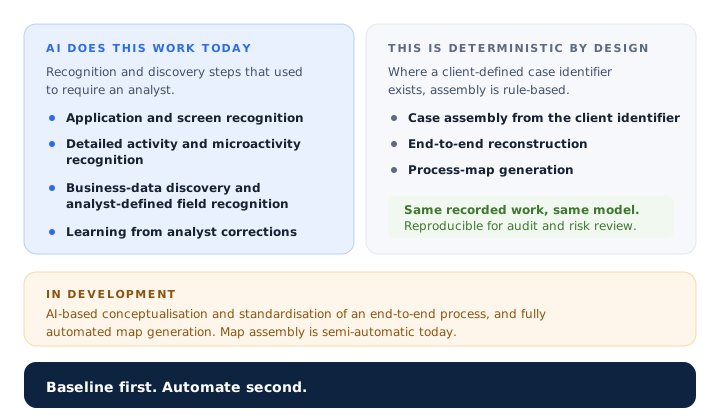
These are not roadmap items, and they are not everything the platform does. Each layer below describes a recognition problem where AI genuinely outperforms an analyst — what it replaces, and the advantage it creates.
AI recognizes which application and which specific screen an employee is working in, across web, desktop, legacy and custom environments.
What it replaces. Someone mapping screens by hand, application by application, before any analysis can begin.
What you get. Observation can cover the whole operation rather than the handful of applications somebody had time to configure.
AI recognizes the discrete activities inside a screen — what was searched, entered, approved, rejected, re-opened or escalated — down to microactivity level.
What it replaces. An analyst sitting behind an employee with a stopwatch, or a workshop where people describe what they think they do.
What you get. You learn what work was accomplished, not just that an application was open for three hours.
Compound AI recognizes the business data on observed screens and assembles it into a business-data dictionary tied back to the process.
What it replaces. Manual field mapping, or accepting that the process evidence carries no business context at all.
What you get. Process evidence that carries your actual business data, so findings can be segmented by product, region, value band or customer type.
AI recognizes the decision points inside the work — where the operation branched, and on what basis.
What it replaces. Inferring decision logic from documentation that describes the intended process rather than the performed one.
What you get. Variation can be explained rather than only counted, which is what makes it fixable.
When a process engineer corrects a recognition output, that correction feeds back and improves subsequent recognition.
What it replaces. Repeating the same manual correction on every engagement.
What you get. Accuracy improves as the engagement proceeds instead of staying fixed at day-one quality.
Once recognition outputs are approved, the rest of the pipeline runs on our proprietary patented algorithms. This is a deliberate choice, not a gap. It is what allows a finance team, an auditor or a risk function to re-run a result and get the same answer — and it is why the platform stays economical at enterprise scale instead of consuming model capacity on work that does not need it.
Approved recognition outputs are associated to your own case identifier and assembled into complete case traces.
Multiple case traces are combined into end-to-end process paths and variants, from initiation through outcome.
Map generation is deterministic. Map assembly is a guided, engineer-reviewed step rather than an unattended one.
A vendor can be heavily automated and barely use AI, or run everything through a model and produce something expensive that nobody can reproduce. Inside Stereologic, AI does the recognition and our patented algorithms do the assembly.
A process engineer reviews, corrects and approves recognition outputs at defined checkpoints. Only approved outputs move downstream into case assembly and reconstruction.
Recognition errors compound. A misrecognized activity becomes a wrong case trace, becomes a wrong variant, becomes a wrong number in a business case. Catching it at the point it is introduced costs minutes; catching it in a steering committee costs the programme’s credibility.
You can validate every step of the methodology. That is the difference from the standard approach, where the AI work is hidden inside a black box and the customer is asked to trust the output. Stereologic is not zero-touch self-service and we do not position it that way — the review step is why the output is safe to put in front of finance, audit or a regulator.
Applications, screens, business data, detailed activities and decisions.
Reviews, corrects and approves that output at defined checkpoints.
Approved output feeds case traces, end-to-end reconstruction and process-map generation.
This is not zero-touch self-service. It is a controlled pipeline with a human approval gate between recognition and assembly.
Assembly and reconstruction are deterministic. Map assembly is a guided, engineer-reviewed step, not an unattended one.
That is deliberate. In audited and regulated environments, a result you can reproduce and defend is worth more than a result that arrives without supervision.
Not without first solving the same problems. Somebody has to design and run screen recording across many desktops, then get the assistant to reliably identify which application and which screen the work happened on — several screens often share one window title — read the business data and its values, separate a real process step from screen navigation, reconnect interrupted work, separate parallel tasks, and tie all of it to a case. Each is a sustained prompt-engineering effort, and each has to return the same answer every time or the number built on it cannot be defended. Stereologic has solved that recognition work, with engineer approval at defined checkpoints and deterministic assembly downstream. The longer answer is here.
AI performs the recognition work. It recognizes the applications and screens an employee is working in, recognizes detailed activities and microactivities within them, recognizes the business data on those screens and assembles it into a business-data dictionary, recognizes the decisions being taken, and learns from the corrections a process engineer makes. That recognition is what turns raw observed work into something a business can reason about.
No, and this is deliberate. Once recognition outputs are approved, case assembly against your case identifier, end-to-end process reconstruction and process-map generation are deterministic. The same recorded work and the same model produce the same result every time.
Because the output has to survive scrutiny. When a finance team, an auditor or a risk function asks how a number was produced, a deterministic reconstruction can be re-run and will produce the same answer. A probabilistic one cannot make that promise. AI is used where recognition genuinely needs judgment; determinism is used where reproducibility matters more than autonomy.
Yes. A process engineer reviews, corrects and approves recognition outputs at defined checkpoints before anything moves downstream into case assembly and reconstruction. Stereologic is not positioned as zero-touch self-service, and the review step is what makes the AI outputs safe to build a business case on.
Processing stays within the approved deployment environment. Stereologic supports on-premises, customer-cloud and dedicated hosted deployment, and the Security and Compliance Pack sets out the AI-processing boundary in detail for technical reviewers.
“AI-powered” on its own tells an evaluator nothing, because AI spans many rapidly evolving capabilities. What matters is which specific step AI performs, which steps deliberately do not use it, whether a human approves the output, and whether you can validate the method rather than trust a black box. This page answers those questions layer by layer.
AI-based conceptualisation and standardisation, and fully automated map generation, are in development.
Bring your architecture reviewer. We will walk the recognition layers, show where the model is deterministic, and hand over the documentation your risk function will ask for. If policy decides the answer, the deployment, the AI layer and the models used are all choices you make before discovery begins.
Reviewing for procurement? Explore Security & Deployment