Timing and frequency analysis
How long each activity and each case takes, how often it runs, how much of the workday it consumes, and how time is distributed across systems, teams and clients.

Deep Task Mining™ brings the observed employee work and the business data inside the applications — and it does not need your event logs to start. Where event logs already exist and are usable, Process Mining is layered on to extend coverage into the system-recorded layer. Together they explain what the work costs, why it behaves that way, and which change is worth making first, with the evidence still attached to every number.
Process documents hold high-level information — the intent, not the execution. They do not show the swivel-chair steps between applications, the rework loops or the judgement calls people make on screen. Process Intelligence is where that missing evidence is assembled into something a decision can rest on.
Process mining sees the shape. Task mining sees the detail. Stereo sees both.
Every item below is derived from observed work, so each number can be opened up and traced back to the activities and screens behind it.
How long each activity and each case takes, how often it runs, how much of the workday it consumes, and how time is distributed across systems, teams and clients.
Where the same process is performed differently, and how far daily practice has drifted from the standard the organization believes is in place.
Where cases queue, stall or take a path that should not exist, including missing steps, extra steps and out-of-sequence work.
Why the delay happens — a legacy system, an awkward interface, poor incoming data quality or a handoff between teams — traced to the step that produced it.
Effort compared across teams, sites and case types, with the time consumed by non-value-adding activity made explicit.
Each opportunity sized in time and effort so it can be ranked against the others, rather than collected in a list.
Analysis that stays inside the tool changes nothing. These are the artifacts that leave it.
Automating a process nobody has measured automates the waste inside it. The same is true of an AI pilot, a system replacement or a target operating model: without a measured before-state, the improvement is an assertion.
A baseline built from observed work is what makes both the business case and the eventual result defensible — to a finance partner, to an internal audit team, and to the executive who approved the spend.
Where a team needs proof on a defined scope and a fixed timeframe rather than a platform decision, the 30-Day Value Leakage Audit is the paid evidence step: one operational area, quantified in hours and dollars, with the method written down.
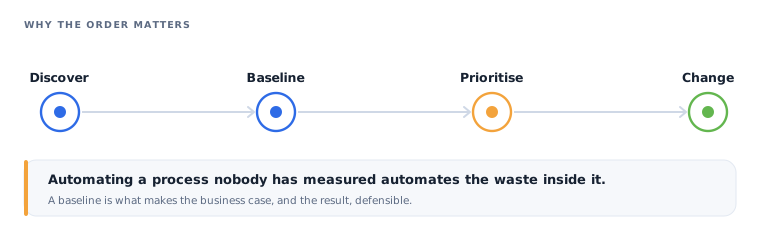
Why the order matters.
Being told that a team spends too long updating client records is not an answer. Process Intelligence carries the evidence underneath the number.
Whether a delay is a one-off or a repeating pattern, and what is producing it — a legacy system, an interface, incoming data quality or a collaboration gap.
For a given measure, a detailed replay of the activities behind it: the screens used, the time spent and the systems involved.
Detected inefficiency is expressed in effort, so an improvement or automation case rests on measured hours rather than estimates.
Where a best practice exists, deviations, missing steps and steps that should not be performed are visible by team and by case type.
Cost and capacity, transformation, automation readiness or standardization — start with the outcome you are being asked to quantify.
Start from the problemExplore solutionsOne operational area, quantified in hours and dollars, with the method documented.
Prove it on a defined scope30-Day Value Leakage AuditProcess Intelligence only reads as well as the discovery beneath it: the process-level map and the detailed activity inside the applications.
See the layers underneathProcess DiscoveryProcess Intelligence sits on top of approved recognition outputs. That ordering matters when someone asks how a number was produced.
Stereologic assembles case traces from approved, recognised activity, then combines them into end-to-end paths and variants. Assembly is deterministic: the same evidence produces the same result.
Bring one operational area and the number you are being held to. We will show how discovered activity becomes timing, variation, root causes and a ranked set of opportunities with the method attached.