Transformation and modernization

Modernize without guessing.

Understand and measure how the operation runs today before changing systems, workflows or operating models — then use the same measurement to run the rollout and validate the result afterwards.

Why the order matters
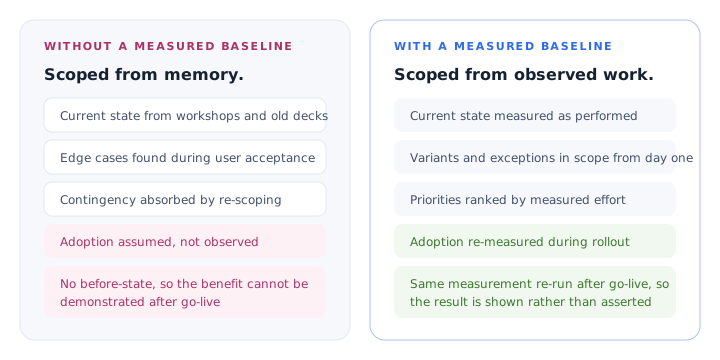
Without a measured baseline a programme is scoped from workshops and old decks, finds edge cases during user acceptance, absorbs contingency in re-scoping, assumes adoption and cannot demonstrate the benefit. With one it is scoped from observed work, has variants in scope from day one, ranks priorities by measured effort, re-measures adoption during rollout and re-runs the same measurement after go-live.

The same programme, with and without a measured current state.

The problem

The questions a programme cannot answer about itself.

Transformation in a complex operation is hard for an unglamorous reason: the systems, the process and the way people actually work have drifted apart, and part of the real process was never written down at all.

Every business case has to answer the same set of questions before anyone can responsibly sign it. In most programmes they are answered from institutional memory, a current-state deck built during the last initiative, and a round of workshops with whoever was available.

  • Which processes should be prioritized — and which ones are quietly carrying the cost?
  • Should this process be re-engineered, or automated as it stands?
  • What is the true scope of the change, including the edge cases nobody listed?
  • What does the current state actually cost, in hours rather than headcount?
  • How will we validate the result once the programme has been delivered?
  • How do we stop over-planning work we do not yet understand?

The expensive version of this

A programme that starts without a measured current state does not usually fail loudly. It absorbs its contingency in re-scoping, discovers the edge cases during user acceptance testing, and finishes unable to demonstrate the benefit it was funded to deliver.

Before, during and after

Discovery earns its place at three points, not one.

Most tools in this category are used once, at the start, to draw the current state. The same measurement is worth more if it runs through the programme and out the other side.

  1. Before: establish the baseline

    Map the current state as it is performed, edge cases included. Discovery runs across the applications and teams in scope without a log-extraction project and without software on employee devices, so the programme does not spend its first phase building a picture.

    • an accurate, measured baseline of the work in scope
    • current-state process maps including the variants and exceptions
    • why deviations happen, traced to the step that produced them
    • a business case built on observed activity rather than estimates
    • a projection of the value the change should return, tied to your own assumptions
  2. During: run the rollout on evidence

    Phased delivery is where adoption is won or lost. The same discovery, re-run against the new way of working, shows whether people are using the new system as designed — and where they have gone back to the old workaround.

    • adoption and utilization of the new system, by team and case type
    • process, system and human failure points surfaced for triage
    • generated user manuals for just-in-time training
    • delivered efficiency compared against the projected benefit
    • service levels tracked against the benchmark that was set
  3. After: validate and stabilize

    Benefit realization is an evidence problem. Measuring the production environment against the original baseline shortens the stabilization period and turns the benefit claim into something an audit team can check.

    • the delivered result compared to the measured before-state
    • residual delays and compliance deviations identified
    • user, training and system issues separated from each other
    • capacity and staffing models revised on real numbers
    • a baseline in place for the next wave

See how the discovery underneath this works

Why the baseline comes first

A programme without a measured before-state cannot prove that it worked.

This is the part that is easiest to skip and hardest to recover. Once the system has changed, the old operation no longer exists to be measured.

Edge cases in scope from day one

The exceptions and variants that normally surface during testing are visible in the current-state map, when they are still cheap to design for.

No workshop backlog

Discovery does not depend on subject-matter experts being available, and it asks nothing of the workforce — no-install recording with non-intrusive desktop-recording software, no change to how people work.

A business case on observed work

Scope, effort and expected return are derived from measured activity, so the numbers in the approval paper and the numbers in the post-implementation review are the same numbers.

A result that can be validated

Before and after are measured the same way, which is what makes benefit realization a comparison rather than an assertion.

How a baseline is measured and maintained

What you get

What the programme team actually receives.

  • Current-state process maps covering the variants and edge cases, with time and frequency against each activity.
  • A defensible operational baseline that the business case, the rollout and the post-implementation review are all measured against.
  • Requirements and use cases in standard format, for the team implementing on the target BPM, ERP or core platform.
  • Generated SOPs and user manuals for just-in-time training during phased delivery.
  • A prioritized change list that separates what should be re-engineered from what should be automated as it stands.

Where this overlaps with the cost case

Transformation programmes and cost programmes usually want the same discovery with different arithmetic on top of it. If the immediate ask is an operating-cost number rather than a modernization scope, start there instead.

Reduce cost and recover capacity

Evidence

Two measured before-states, with their scope attached.

Fewer stories, stronger evidence. Each of these carries its context, its method and its source.

Named customer

Pitney Bowes

A back-office operation measured, changed and measured again on the same terms.

  • 30%Operational cost reduction
  • 56%Customer-service acceleration
  • 20% → 0%Errors in servicing customers

Back-office customer management operations at Pitney Bowes. Results achieved in under 90 days.

Read the story

Anonymized analysis

Global Health Insurance Company

What a current-state baseline found before anything was re-engineered.

  • 69%Offshore FTE savings opportunity identified
  • 35%Onshore FTE savings opportunity identified
  • +5claims/hour offshore throughput opportunity

3,053 claims across 107 subtypes. Identified opportunities, not realized savings; the 69% applies to active time only, which was 65% of total time.

Read the analysis

Explore customer results

In their own words

A senior operator on what the evidence changed.

Scott Gorman was SVP Operations at Genworth Canada, now Sagen, at the time of the engagement.

Role held at the time of the engagement. Published interview.
Take the next step

Baseline the operation before you change it.

Bring the scope of a programme you are about to approve, or one already underway that cannot yet describe its current state. We will show what a measured before-state looks like on that work, and what it changes about the plan.