
Why Stereologic

Understand and measure the real process before you change it.

Automating or applying AI to a process nobody has measured automates the waste inside it — and leaves the result unprovable, because there was never a before-state to compare it against. A measured baseline is what makes the business case defensible — and the result checkable afterwards.

Baseline first
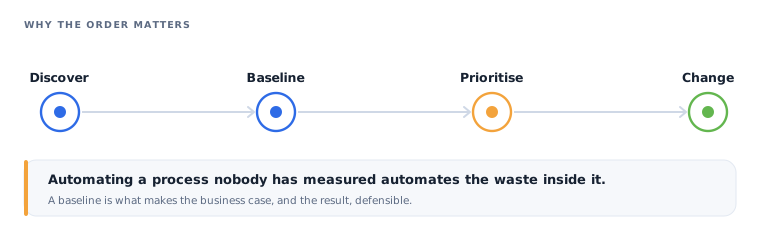
Four stages in order: discover, then baseline, then prioritise, then change — with the note that automating a process nobody has measured automates the waste inside it, and that a baseline is what makes the business case and the result defensible

Discover and baseline before you prioritize or change.

The argument

The shortcut is the expensive route.

Nothing here argues against automation, AI or transformation. It argues about order — because the order decides whether the result can be proved.

An agent, a bot or a redesigned workflow inherits whatever process it is pointed at, including every exception, workaround and hidden application nobody documented. Autonomy is exactly why the underlying work has to be known first: software given an incomplete picture of the work does not degrade gracefully. It acts confidently on the wrong understanding.

The second cost is quieter and arrives later. If the current state was never measured, the saving afterwards cannot be evidenced either — there is no before-state to compare against, so the outcome becomes a matter of opinion at exactly the moment someone asks finance to fund the next wave.

Two ways to start, and what each one costs later
Compared onStart with the changeStart with the baseline
Starting pointThe process as documented, or as somebody believes it works.The process as performed, observed across applications, including the exceptions.
The first exceptionWork nobody mapped, met at run time, handled confidently and wrongly.Already visible — so it is designed for, standardized, or deliberately left with a person.
The business caseRests on an estimate of the current state that nobody outside the room can interrogate.Rests on a measured before-state, with the calculation method shown.
What happens nextStuck in pilot, then rebuilt at close to full cost.A provable result, and a second wave that is easier to fund.

Automating a process you haven’t mapped doesn’t remove the problem. It scales it.

What breaks

Five things that break when the baseline is skipped.

These are the failure modes we are called in after, and each one is a symptom of the same missing input: nobody measured the work.

01

Data nobody can trust

Ungoverned, unstructured work sitting in legacy systems, spreadsheets and applications nobody inventoried produces unreliable outputs downstream. Discovery finds and organizes it before it is depended on.

02

No view of the as-is process

Without a picture of what people actually do, in what order, with how much rework, effort is aimed at the wrong steps entirely — usually the visible ones rather than the expensive ones.

03

Workflows that do not fit the work

A design built against an assumed flow stalls the moment it meets a real exception. Task-level evidence shows which steps carry the variation before anything is built on top of them.

04

Employees who do not trust the change

People resist systems they cannot see working against their own tasks. Observing work with non-intrusive, no-install desktop-recording software and no Administrator-level endpoint access, and without changing how they work, keeps the change legible rather than threatening.

05

Leadership deciding without evidence

Prioritization becomes a matter of who argues best. Measured time, frequency and variation turn the same conversation into a decision about which number to attack first.

Where Stereologic is different

Three differences that decide what you can prove.

The homepage states these in a line each. Here is what each one actually means when a programme depends on it.

Add the layer the records miss

System and process evidence is real, and Stereologic uses it. It is one layer. The operation also happens between those records — the lookups, the re-keying, the spreadsheet step, the email that unblocks the case, the exception path that three people know about. Stereologic adds that human and inside-application activity to the picture rather than replacing what your systems already tell you.

Stereologic observes the work itself rather than its transaction trail, so the undocumented part of the process is measured instead of assumed.

  • web, desktop, Excel, email, legacy and custom applications
  • undocumented exceptions, workarounds and rework
  • systems that keep no usable log at all
  • no data-log preparation and no connector build to begin

Non-intrusive, no-install desktop-recording software

Recording runs without installation on employee machines, and nobody is asked to change how they work. That removes the two objections that usually stall discovery: an endpoint rollout IT has to own, and an employee-monitoring conversation nobody wants to have.

It also shortens the security review, because the question moves from what you are putting on our estate to where the platform runs.

  • non-intrusive desktop-recording software
  • no change to how people do their work
  • on-premises or within the approved hosted or cloud environment
  • on-premises data stays on-premises; hosted data stays within that cloud; processing remains in the agreed jurisdiction

Evidence your teams can use

Discovery that ends in a slide deck changes nothing. The output here is a set of operational artifacts that transformation, automation and operations teams can work from directly — and that survive the engagement.

The same artifacts are what make a later saving provable, because the before-state was written down and measured.

  • end-to-end process maps and task-level detail
  • generated SOPs and process documentation
  • requirements and use cases for automation work
  • a measured operational baseline and prioritized opportunities

See how deployment and data handling work

The sequence

Four steps, and the first two are the ones people skip.

Discovery does not wait on a log-extraction project or a connector build, which is why the first two steps can happen before the programme is committed rather than after it has stalled.

  1. Discover

    Find every application, document and manual step inside the scope — including the ones that never appear in a system log.

  2. Baseline

    Reconstruct how the work is really performed, with volumes, timings, variation, error paths and rework made explicit and measurable.

  3. Target

    Decide what to standardize, what to improve, what is genuinely worth automating and what should stay human — against evidence rather than enthusiasm.

  4. Prove

    Change runs against a verified process with a measured before-state, so the result is provable and the next wave is easier to fund.

The paid version of steps one and two

The 30-Day Value Leakage Audit is this sequence inside a defined scope and a fixed period: the work mapped as performed, leakage quantified in hours and dollars, and a baseline your team keeps.

Explore the 30-Day Value Leakage Audit

Reasons to believe it

Long-standing, patented, and careful with numbers.

Two of the three reasons to believe are on the record. The third is how we treat the record itself.

30%Operational cost reduction
56%Customer-service acceleration
20% → 0%Errors in servicing customers
Under 90 daysResults achieved

Back-office customer management operations at Pitney Bowes. Figures are drawn from Stereologic’s published Pitney Bowes case study.

18 years of operational discovery3 granted patents

How we handle numbers

No outcome is published on this site without its customer context, its scope, its timeframe, its calculation method where one is required, and confirmed permission to publish it. That rule costs us some impressive figures. It is the same standard we hold your baseline to, which is the point.

Explore customer results

For the reviewer who has to sign it off

Deployment options, data residency, the no-endpoint-agent position and the security and compliance documentation available for procurement are set out in one place, so a security review can be run early rather than discovered in month three.

Explore Security & Deployment

Evaluating alternatives

Looking at other vendors too?

We publish honest architectural comparisons with the vendors most often evaluated alongside us, written from their own public documentation. Each one shows how the approaches differ and why those differences matter operationally.

Take the next step

Bring one process you are about to change.

We will show you what a measured baseline of it would look like — one workflow, about twenty-five minutes, no customer data and no obligation for the first conversation.