Variation nobody chose
The same process performed several ways across teams and sites, each version defensible on its own terms and none of them measured against the others.

Expose process variation, workarounds and undocumented steps so teams can create a reliable operating standard — written from the best version of the work that already exists, not from a workshop.
The same work is performed differently across teams and sites. Some of that variation exists for a real reason. Measurement is what tells you which is which — and it is what ends the argument.
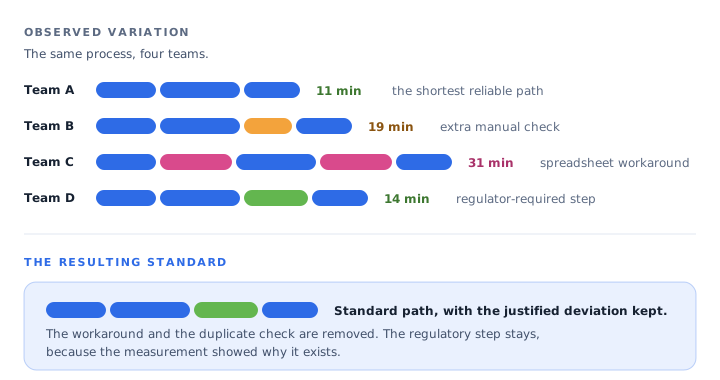
In a complex operation this is not a failure of discipline. It is what happens when a process meets fifteen years of system changes, product launches, acquisitions and staff turnover.
Variation is rarely a decision anybody made. One team hit a case the process did not cover and invented a step. Another inherited a workaround from a system that was decommissioned two upgrades ago. A third does it correctly, and nobody knows which one that is. The result is an operation where the same work produces different cost, different cycle time and different error rates depending on who picks it up.
The same process performed several ways across teams and sites, each version defensible on its own terms and none of them measured against the others.
The extra lookup, the side spreadsheet, the colleague you ask when the case is unusual. Undocumented, load-bearing, and invisible until they retire.
A best practice exists on paper. Whether it is being followed, by whom and on which case types is a matter of belief rather than measurement.
You cannot negotiate a standard from anecdotes. The first job is to put every version of the process on the table with its real cost attached.
Discovery reconstructs the process independently for each team, site or case type in scope. Two discovered processes can then be compared step by step, with the activities they share and the activities they do not highlighted against each other. The comparison is quantitative: each version carries its own frequency and duration, so the difference between two ways of working is expressed in time rather than in preference.
That is what turns a standardization programme from a negotiation into an analysis. The variants that exist for a real reason — a different product, a regulatory requirement, a system that only one site runs — separate cleanly from the ones that exist because nobody ever revisited them.
Variation lives in exactly the places a system log cannot see: the manual step between two applications, the spreadsheet, the email approval, the workaround. Discovery that depends on event logs finds the variants the systems happened to record.
Most operations do not need a process invented for them. They need the version that already works identified, documented properly and made repeatable.
The most efficient observed path becomes the candidate standard, with the measured evidence for why it is the one to adopt.
Standard operating procedures generated from how the work is actually done, including the system screens involved at each step.
Step-by-step user manuals for onboarding and just-in-time training, so new staff learn the standard rather than inheriting the nearest workaround.
The painful cases are documented as part of the standard, which is the difference between a procedure people follow and one they route around.
The failure mode of standardization work is not the document. It is month nine, when three sites have quietly gone back to their own version and nobody noticed.
Conformance is presented by team, site and case type rather than as individual scoring, and obfuscation removes private employee and client data from what is captured and shown. Recording runs without installation on employee devices and nobody is asked to change how they work.
Back-office customer management operations at Pitney Bowes. Figures are drawn from Stereologic’s published Pitney Bowes case study.
No — and that is rather the point. Discovery observes the work as it is performed, so the documented process is treated as a comparison rather than a prerequisite. Where a standard already exists, the useful output is the gap between it and daily practice.
Some of them will be right. Measured variation separates the versions that exist for a real reason — a different product, system or regulatory requirement — from the ones that exist because someone left and the workaround stayed. Each version carries its own frequency and duration, so the discussion moves from opinion to cost.
Conformance is reported at team, site and case-type level rather than as individual scoring. Recording runs without installation on employee devices, people are not asked to change how they work, and obfuscation removes private employee and client data from what is captured and shown. See Security & Deployment.
A workshop produces the process people believe they follow. Discovery produces the one they actually follow, exceptions included, and generates SOPs from it with the system screens attached to each step — so a reviewer can see the step rather than a description of it.
Choose one process that two or more teams perform differently. We will show what the versions actually are, what each one costs, and which of them deserves to become the standard.