The work as performed
End-to-end process views and task-level detail for the agreed scope, including the variants and exceptions that do not appear in the documented process.

The Value Leakage Audit takes one agreed operational scope, maps how the work is actually performed, quantifies what the leakage is worth in hours and dollars, and hands your team a measured baseline for what to improve, automate or transform next.
Most operational business cases are built on an estimate of the current state. The audit replaces that estimate with a measurement — taken from the work as it is actually performed, inside a scope narrow enough to finish in thirty days and large enough to matter.
Automating or applying AI to a process nobody has measured automates the waste inside it, and leaves the saving unprovable afterwards because there is no before-state to compare against. The audit exists to remove that problem in a controlled scope, at a controlled cost.
Nobody buys a diagnostic from a web page. The audit is what a serious evaluation turns into once the earlier steps have done their job.
You recognize the operational problem — cost, capacity, cycle time, standardization, or an automation programme that needs a defensible starting point.
You test whether Stereologic is credible and deployable: the differentiation, the customer evidence, and whether it can pass your security review.
Twenty-five minutes on one workflow, with no customer data and no installation, to see what would become visible.
The audit. A controlled scope, a fixed period, and a quantified answer you own at the end of it.
The audit is designed to produce operational artifacts rather than a consulting narrative — material that stays useful after the thirty days, and stays useful if you choose a different vendor for whatever comes next. The exact deliverable set is confirmed with you when the scope is agreed, and is fixed in writing before work begins.
End-to-end process views and task-level detail for the agreed scope, including the variants and exceptions that do not appear in the documented process.
Time, frequency and variation measured activity by activity, so the loss is attributed to specific steps rather than to a department.
Leakage converted using your own volumes and cost assumptions, with the calculation method shown so it survives review.
What to standardize, what to improve, what is genuinely worth automating, and what should stay human — ranked by evidence.
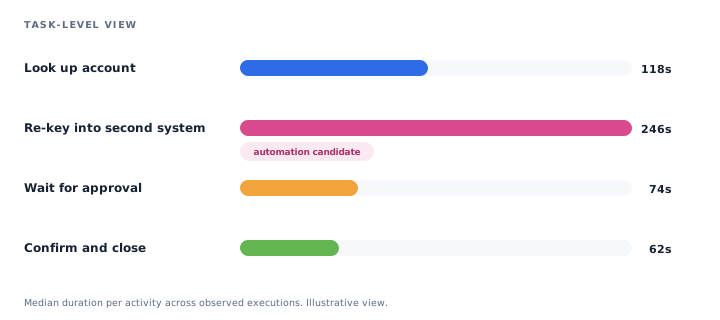
Illustrative view. This is the level at which leakage is attributed — activity by activity, not department by department.
The same artifacts feed the next decision: process maps and SOPs for a standardization programme, requirements for an automation build, and the measured before-state that makes any later saving provable rather than asserted.
The period is fixed so the answer arrives while the decision is still open. The phases below describe the shape of the engagement; the calendar, the access required and the deliverables for each one are set with you when the scope is agreed.
Fix the boundary of the work, the volumes inside it, the metric it will be measured against, and who signs off the result. Deployment and security review happen here rather than at the end.
Work is recorded non-intrusively as it is performed across and inside applications — including email, spreadsheets, desktop, legacy and custom environments — no-install, with non-intrusive desktop-recording software, no change to how people work, and no log-extraction project standing in front of the first evidence.
Activity is connected into the actual process end to end and at task level, then measured: timing, frequency, variation, bottlenecks, rework and the undocumented steps. The measurement is converted into hours and dollars against the cost assumptions agreed in phase one.
The findings are walked through with the people who own the process, not just the sponsor: what the work actually looks like, where the leakage is, what the number is and how it was calculated, and which moves the evidence supports next.
Two things: a scope that does not move, and a decision-maker who is available at the start and at the end. Discovery itself does not wait on an integration backlog or a data-preparation project, which is why a fixed period is realistic at all.
The target is set, the number is contested, and nobody can evidence where the hours actually go. The audit produces the evidence inside one scope instead of arguing about the whole function.
Systems, workflows or an operating model are about to change, and the current state is documented as somebody believes it to be rather than as it is performed.
Pilots are stalling on exceptions nobody mapped, or the business case for the next wave depends on a before-state that was never measured.
Teams, sites or acquisitions have drifted apart, and the variation has to be visible before a standard can be written that people will actually follow.
If you cannot yet name one scope and one metric, the audit is premature — start with the conversation instead, and use it to find the scope worth measuring. Twenty-five minutes, no customer data, no obligation.
Back-office customer management at Pitney Bowes delivered 30% lower operational cost, 56% faster customer service response and servicing errors from 20% to 0%, measured in under 90 days — from Stereologic’s published case study.
Once the real operation is understood, leakage is evaluated across four business lenses. Different leak, different intervention — then re-measured against the same baseline.
Where is workforce time being consumed or misallocated? Low-value manual work, task switching, workload imbalance.
What you do: rebalance roles and workload to recover usable capacity.
Where does work wait, loop or move backward? Bottlenecks, handoffs, rework.
What you do: redesign routing and handoffs to improve throughput.
Where do systems and data create unnecessary work? Manual copy and paste, duplicate or fragmented data, screen delays.
What you do: fix integration and data, and automate where the evidence supports it.
Where does actual execution differ from expected performance? Skipped steps, workarounds, errors and execution variation.
What you do: standardize SOPs and controls, and coach the teams that drift.
| Fee | $50,000 USD, fixed, per operational scope. Creditable toward a Stereologic licence. |
|---|---|
| Duration | 30 days from scope sign-off to delivered findings. |
| Scope | One agreed slice of operational work. The boundary, the volumes and the metric it will be judged against are written down before anything begins. |
| Deliverables | Process views and task-level detail for the agreed scope; leakage quantified in hours and dollars using your volumes and cost assumptions, with the calculation method shown; and a prioritized set of next moves. Confirmed in writing at scope sign-off. |
| Ownership | The artifacts are yours to keep and remain usable if you choose a different vendor for whatever comes next. |
| Deployment | Non-intrusive, no-install desktop-recording software and no Administrator-level endpoint access. Deployment and security review are completed during scope agreement, not at the end. |
Fee stated in US dollars for a single operational scope. Engagements beyond the audit are quoted separately.
Start with twenty-five minutes on one workflow. If it is worth quantifying, we will agree a scope, a metric and a period — and you will end up with a baseline you can take to your own finance function.
Not ready to meet? See an anonymized claims analysis