
AI and automation readiness

Find the right automation and AI opportunities.

Identify what should be standardized, improved, automated or kept human before more investment goes into AI or automation — because an agent or a bot inherits whatever process you point it at.

The problem

An agent inherits the process you point it at.

Including every exception, workaround and hidden application nobody documented. Automating a process that has not been mapped does not remove the problem — it scales it.

Agentic AI is different from a copilot. It takes on end-to-end work — resolving a customer enquiry, processing a claim — with limited human intervention. That autonomy is exactly why the underlying process has to be known before the agent is switched on. Given an incomplete picture of the work, an agent does not degrade gracefully. It acts confidently on the wrong understanding.

Traditional automation fails the same way for a duller reason. A bot built against a described process meets the undocumented variant in week three, and the cost of the rework lands on the team that was promised the saving.

  • Data you cannot trust. Ungoverned and unstructured content sitting in legacy systems, spreadsheets and applications nobody inventoried.
  • No view of the as-is process. Without knowing what people actually do, in what order, with how much rework, the automation gets aimed at the wrong step.
  • Workflows that do not fit. A design built against an assumed flow stalls the first time it meets a real exception.
  • People who do not trust it. Staff resist autonomous systems they cannot see working against their own tasks.
  • Leadership without visibility. Prioritizing use cases without operational evidence turns a portfolio decision into a preference.
Two ways to start

One of these routes gets rebuilt.

None of this is an argument against agents or automation. It is an argument about order.

The difference is not ambition. It is whether the before-state was measured while it still existed.
Straight to automationBaseline first
Starting pointAn assumed process, described in a workshopThe process as performed, measured across teams and case types
First contact with realityThe exceptions nobody mapped, found in testingThe exceptions found during discovery, before anything is built
What people end up doingRe-checking every output by handHandling the work that genuinely needs judgement
What the business case rests onA projection with no denominatorA measured before-state, in hours and effort
Where it usually endsStuck in pilot, then rebuilt at full costA provable saving and a fundable second wave
What Stereologic does about it

Four steps, and the first two do not wait on a data project.

Discovery observes the work as it is performed, so the baseline can precede the automation programme instead of delaying it.

  1. Discover

    Find every application, document and manual step in scope — including the ones that never appear in a system log, and the office tools people quietly rely on.

    • no log extraction and no connector build to begin
    • no software installed on employee devices
  2. Baseline

    Measure how the work actually happens — volumes, durations, variants, error paths and rework, made explicit rather than estimated.

    • frequency and duration per activity and per case
    • the interruptions that normally distort task timing, separated out
  3. Target

    Decide what an agent or a bot should own, what should be standardized or redesigned first, and what should stay with people.

    • candidates ranked on measured effort, not enthusiasm
    • process maps redesigned against evidence before the build starts
  4. Prove

    Deploy against a verified process with a measured before-state, so the saving is demonstrable and the next wave is easier to fund.

    • the same measurement re-run after go-live
    • residual manual handling and rework surfaced, not assumed away

See the discovery this runs on

How a candidate is judged

Frequency and duration are where ranking starts, not where it ends.

Volume and time will tell you what is big. They will not tell you what is safe to automate, or what would be worse if it were faster.

Frequency and total effort

How often the pattern runs and how much employee time it consumes in total — the arithmetic that separates a real prize from a visible annoyance.

Judgement or data handling

Whether the step involves a genuine decision, or the movement and re-keying of data that could be standardized or automated.

Effect on the customer

What the step does to service quality and customer experience, so automation is not aimed at something that only looks expensive.

Waiting versus working

How much of the elapsed time is queueing rather than effort. A handoff problem does not get better when the handoff happens faster.

See the task-level detail behind these judgements

What you get

What the build team receives instead of another round of workshops.

  • A ranked candidate list separating what to standardize, improve, automate or leave with people — each item sized in time and effort.
  • Detailed specifications for the candidates you take forward: the steps, the screens, the user actions, the systems involved and the time each one takes.
  • Complete scenarios, exceptions included — the painful cases that normally surface after the build, documented before it.
  • Process maps for redesign, so the workflow can be reshaped for automation rather than automated in its current shape.
  • A measured before-state, so the delivered saving is a comparison rather than a claim.

Some of the list will not be an automation job

A ranked list usually shows that the largest single prize is variation, not manual effort — the same work being done four different ways. Standardizing it first is normally cheaper than automating four versions of it.

Standardize complex operations

Evidence

What a baseline found before anything was automated.

Variation discovered in claims work

What we do not publish

Stereologic has larger automation and AI outcomes in its history than the two sets published on this site. They are not shown here because they do not yet carry a customer-approved scope, timeframe and calculation method. A number without those things is not evidence, and an evaluator is right to discount it. Figures are added when they can be sourced, not when they would be useful.

See how outcomes are governed

AI inside Stereologic

Before AI automates your business, Stereologic understands how it really runs.

Where AI does the work, and where the model is deterministic.

There are two AI stories here and they are not the same one. This is the first: what AI is already doing inside the product today, and what it is deliberately not doing. “AI-powered” on its own tells an evaluator nothing.

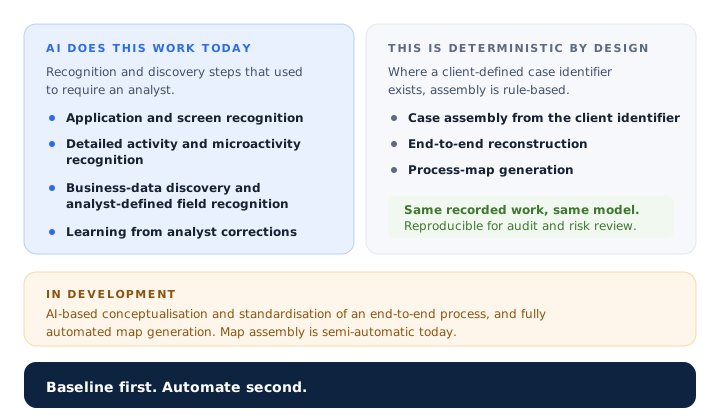
AI does application and screen recognition, detailed activity and microactivity recognition, business-data discovery and analyst-defined field recognition, and learning from analyst corrections. Case assembly from the client identifier, end-to-end reconstruction and process-map generation are deterministic. AI-based conceptualisation and standardisation of an end-to-end process and fully automated map generation are in development.
Where a client-defined case identifier is available, assembly is deterministic by design: the same recorded work and the same model produce the same result, which is what makes the output reproducible for audit and risk review.

AI inside Stereologic

AI performs specific recognition, discovery and analysis steps that previously required analyst time: recognizing applications and screens, recognizing detailed activities and microactivities, discovering business data and analyst-defined fields inside observed cases, and learning from the corrections an analyst makes.

Stereologic before enterprise AI

Separately, and for a different reason: an enterprise needs operational evidence and process context before it automates or agentifies work, because an agent inherits whatever process it is pointed at. That argument stands on its own, regardless of what is running inside our product.

Baseline first. Automate second. Automated is not a synonym for AI. Case assembly and end-to-end reconstruction use deterministic mechanisms; AI is used in the recognition, discovery and analysis steps named above.

Take the next step

See the real process before you automate it.

Name the process you are about to point an agent or a bot at. We will show what a measured baseline of that work contains — the variants, the exceptions and the effort — and which parts of it are worth automating at all.