
The Capability Trap in Digital Transformation
Why exception handling matters before you automate the happy path.
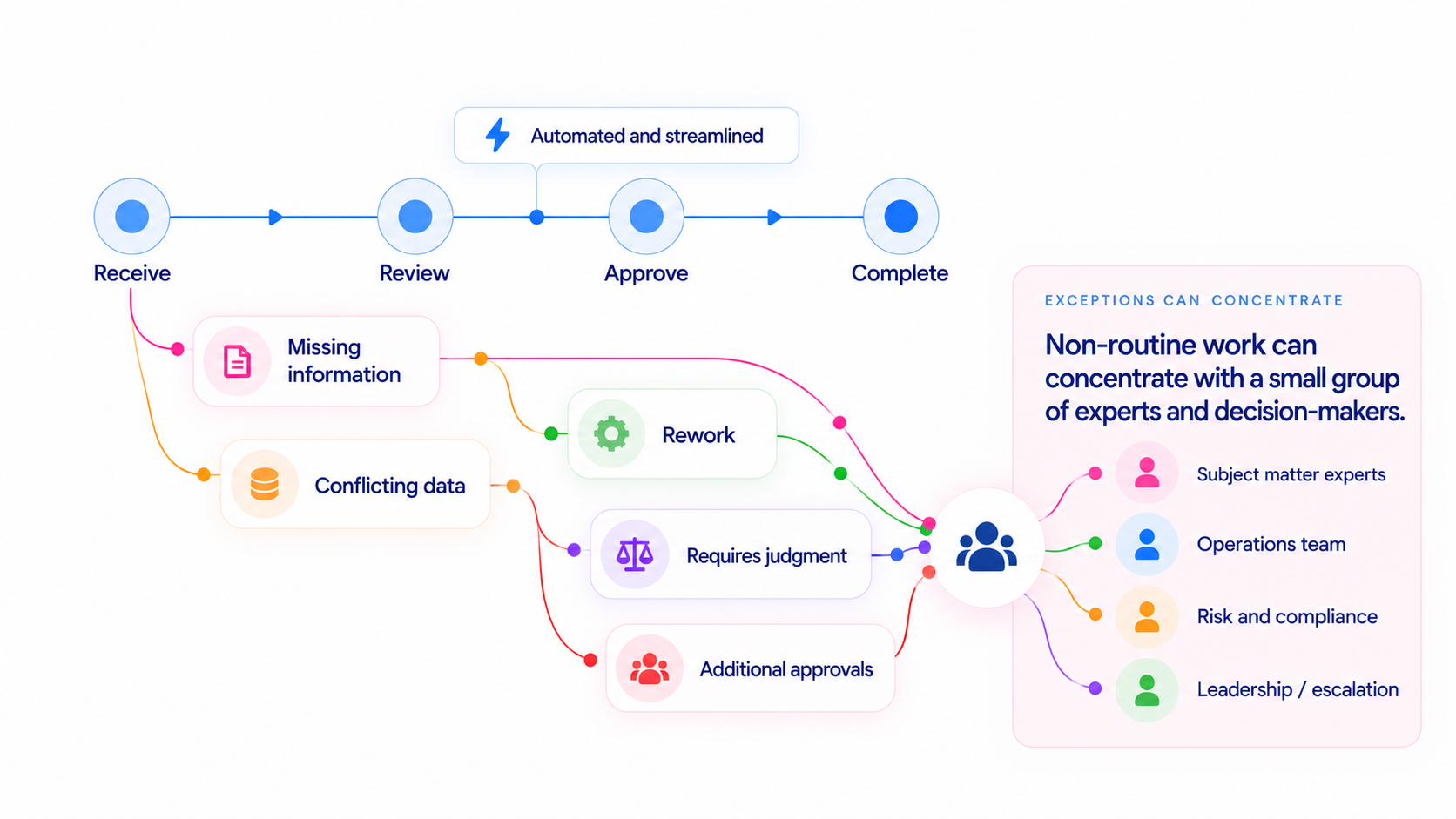
Digital transformation often starts with a clear goal: make routine work faster, more consistent and easier to scale.
A standard case that once needed several manual steps may need only one or two. Even complex work can move without waiting for a person once the path is defined. Common decisions can be handled through clearer rules. Teams spend less time on repetitive activity.
Those are real improvements.
The risk appears when the organization focuses so narrowly on the standard path that it loses sight of the full mix of work coming in.
The unusual case still arrives. Information is incomplete. Two systems disagree. A policy does not quite fit the situation. A case comes back for correction. Someone needs to make a judgment call.
These are the cases where operational capability matters most.
What the capability trap looks like in digital transformation
Repenning and Sterman used the term capability trap to describe a broader management problem. Under pressure to deliver immediate results, organizations can reduce the time and attention spent on learning and process improvement. Performance may improve for a while, but the capability needed to sustain improvement gradually weakens.
Digital transformation can create a similar problem.
As routine work is standardized and automated, people naturally get less practice doing it. That matters because ordinary cases often provide the context through which people learn how an operation behaves, where the rules stop working and what an unusual case actually looks like.
There is another risk too. The reasons behind existing workarounds are not always captured before a process changes.
A step that looks redundant on a process map may exist because somebody learned that a particular system behaves differently in one situation. An informal check may have developed after years of dealing with a certain type of error.
The exception still exists. The knowledge for handling it may not.
Over time, more difficult cases can concentrate with a smaller group of experienced people while the wider team gets less exposure to the full operation.
Lisanne Bainbridge identified a related problem in Ironies of Automation in 1983. As automated systems take over routine work, people can be left responsible for the abnormal situations that are hardest to handle, even while they get less regular practice with the underlying process.
Before removing routine work, understand what people learned from doing it and which parts of that knowledge the operation will still need.
A simple claims example
Consider a claims operation where many cases follow a predictable path.
The information is complete. The policy rules are clear. The claim falls within normal limits. Those cases may be excellent candidates for straight-through processing.
Then there are cases with missing documentation, conflicting information, an unusual customer circumstance, a reopened claim or a policy question that requires experience and judgment.
Automating the predictable work is valuable.
But the workload left for people changes. Reviewers see a higher concentration of difficult cases. Newer employees have fewer ordinary cases through which to learn how the process works. More of the unusual work starts to depend on a smaller group of experienced people.
A transformation team that measures only how many claims can be automated misses an important part of the operating model.
Why exception handling matters in automation
Exceptions are often treated as noise around the real process.
In practice, they can tell you where the process needs attention.
Some are caused by incomplete data. Some come from unnecessary approvals or poor handoffs. Some exist because systems do not fit together cleanly. Some are repeated forms of rework. Others reflect genuine customer or business complexity.
Understanding the cause matters because the remedy is different in each case.
This is why exception handling should be part of the transformation baseline.
The happy path is only one process variant
Many transformation programs begin with a documented process.
Receive the request. Check the information. Make the decision. Complete the transaction.
It is a useful starting point.
Real operations often contain more variation.
A case pauses while somebody asks for information. Work moves into email. A spreadsheet fills a gap between systems. A colleague is asked for advice. A case comes back from a later stage because something earlier was wrong. Different teams reach the same result in different ways.
Some of that work is waste.
Some of it is how the operation currently survives.
Before changing the process, those two need to be separated.
Otherwise, a transformation program can remove a workaround without removing the reason the workaround existed.
Seeing the work outside the standard path
System records are useful for showing what happened in systems that generate usable event data. Application-usage data can also show where time was spent.
Understanding an exception may require more detail: what work was actually performed, what information was used, what decision was made, where someone moved between applications, where the work stopped and what happened when the case returned.
This is where Stereologic’s Deep Task Mining™ fits.
It connects observed activity inside and across applications to the business work being accomplished, including decisions, interruptions, variants, handoffs and outcomes.
Those activities can be reconstructed into cases and end-to-end processes. Combined with process-level evidence, Process Intelligence can show how the standard path and its variations actually behave.
The purpose is practical. Teams need enough evidence about the real operation to decide what should happen next.
Six possible answers to an exception
Once the work is visible, exceptions can be handled deliberately.
Remove it by fixing the root cause.
Standardize it where different teams are solving the same situation differently.
Improve it where the process creates unnecessary effort or delay.
Automate it when the rule is clear and repeatable.
Assist it with AI while keeping the appropriate human decision or validation.
Keep it human where context, judgment or risk makes that the right operating choice.
The important part is making that decision from evidence rather than assuming every variation should eventually disappear.
Five questions to answer before automating the happy path
Before removing routine work from an operation, answer five questions.
1. What are the real process variants?
Look beyond the documented procedure to the paths that cases actually take.
2. Which exceptions repeat?
Recurring exceptions often point to a process, data, system or policy problem.
3. What does each exception consume?
Consider effort, capacity, customer waiting, rework and quality risk.
4. Where does human judgment genuinely matter?
Separate work that is simply difficult to automate from work where context and judgment create value.
5. What happens to that capability after the standard work changes?
Who receives the difficult case? What information will they have? How will people learn to resolve it? How will the result be measured?
If those questions are difficult to answer, there is a gap in what the organization currently understands about the process it is transforming.
Avoiding the capability trap
A stronger transformation sequence starts with the real operation.
Measure the standard path and the work around it. Understand the exceptions, interruptions, workarounds, rework and judgment calls. Identify which capabilities will disappear with routine work and which ones the business will continue to need.
Then make the change and measure the operation again against the same baseline.
A successful digital transformation should make normal work easier.
It should also leave the organization better prepared for the moment reality stops following the normal path.
Where this goes next
Stereologic measures work as it is actually performed, including the variants, decisions, interruptions, handoffs and rework that sit outside the standard process description.
The 30-Day Value Leakage Audit creates a measured baseline for one agreed operational scope, helping teams decide what to remove, standardize, improve, automate, assist with AI or keep human before larger transformation decisions are made.
Find out where value is leaking out of your operation.
One agreed scope, thirty days, a measured baseline and an executive readout.