
Stop Guessing at AI ROI. Measure the Actual Work.
Before approving an AI investment, know which business result should move, how the actual work must change to move it, and how you will prove the impact after go-live.
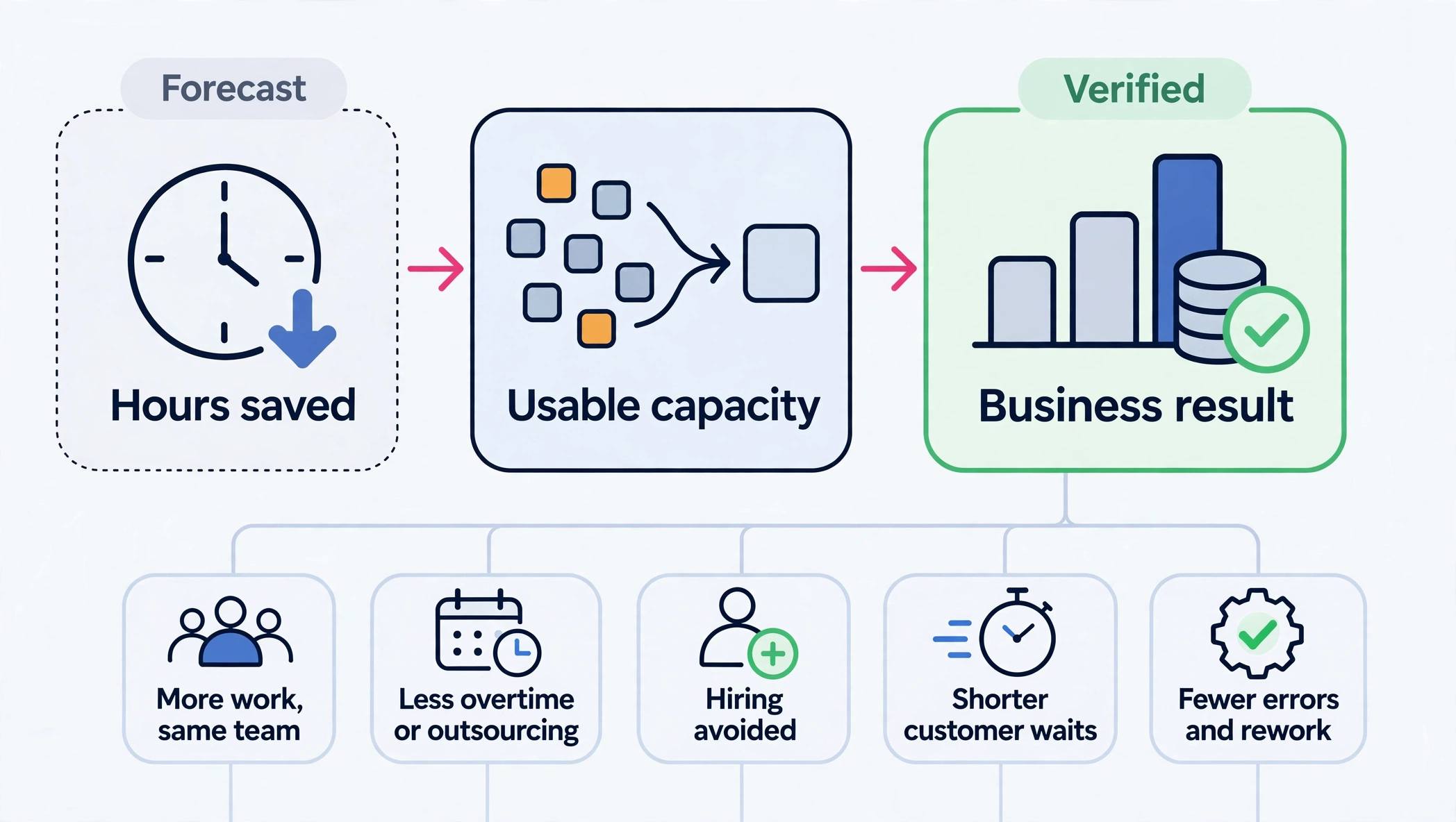
Before approving an AI investment, know which business result should move, how the actual work must change to move it, and how you will prove the impact after go-live.
Start with the business result
For an operations or finance leader, AI ROI should answer one question: if we spend this money, what changes in the business?
The answer should be concrete. Lower operating cost. More capacity from the same team. Faster customer service. Fewer errors, delays, or avoidable exceptions. Without at least one of those changes, an ROI number is just speculation built on assumptions.
A credible AI business case connects three things: the business result, how the actual work must change, and the evidence that will prove the impact afterward.
Three questions before you debate the ROI number
A short test makes the business case easier to challenge before the investment is approved.
| Question | What a credible answer sounds like | |
|---|---|---|
| 1 | What business result should move? | Cost, capacity, service speed, quality, or operational risk. |
| 2 | How must the actual work change? | A delay disappears, rework falls, a tedious routine is automated, or unnecessary work is removed. |
| 3 | How will we prove it? | Measure the same operation before and after the change using the same definitions. |
What this looks like in banking
A major Canadian bank offers a useful example. During a nationwide loan-origination transformation, a new platform had been extensively tested, yet production still exposed errors and system delays. Employees worked around the issues and waited for system responses, affecting adoption and the customer experience.
The executive question was simple: the bank had already invested in the transformation. Was the new operation producing the value it was supposed to? Where were cost and time being lost, what was disrupting service, and would fixing those problems improve both operations and customer service?
In an approved Stereologic case study, the bank recorded how actual client cases were processed at the branch level, giving leadership objective before-and-after evidence to prove incremental ROI with every platform release. In less than six months, this visibility enabled the bank to diagnose and resolve live production friction, including screen freezes, UI navigation bottlenecks, and unexpected system outputs. This cut production errors and delays by 95% in the initial phase, before the bank moved into a cadence of incremental releases backed by credible ROI.
The reported outcomes were:
$15MM
Annual operational cost savings
22.5%
Acceleration of customer services
95%
Reduction in initial production errors and delays
| Annual operational cost savings | Acceleration of customer services | Reduction in initial production errors and delays |
Which business result moved? Annual operating cost dropped by $15MM, alongside a 22.5% acceleration in customer service.
How did the actual work change? Branch advisors processed cases measurably faster (22.5%) and stopped losing hours to UI friction and rework.
What evidence proved it? Objective before-and-after recordings of live case processing across the branches.
The lesson for any AI or technology investment is straightforward: value has to show up in the operation. In this case it showed up in cost, service speed, and fewer errors and delays. Those are outcomes an executive can test.
Hours saved are only the first step
Many AI business cases start with time. A task takes ten minutes today, automation removes three, the annual volume is known, and the model converts the saved minutes into a dollar figure.
That is useful, but it is still a forecast. The next question is what the organization can do with the time that was released.
Can the team process more work without adding headcount?
Will overtime or outsourced work fall?
Can future hiring be avoided as volume grows?
Will a customer wait become shorter?
Will errors or rework fall enough to reduce operating cost?
A saved hour becomes business value when one of those outcomes moves. If the time is scattered across people and days in fragments that cannot be reused, the financial return will be smaller than the modeled labor saving.
Hours saved are an operational estimate. ROI begins when the business can point to what changed because those hours were removed.
Related reading: Where operational value leaks
Count what automation leaves behind
Automation changes the work that remains. Routine activity is usually the easiest to remove first, so the cases left with people can become more exception-heavy and judgment-intensive.
New work can also appear: output review, corrections, escalations, monitoring, or cases the AI cannot complete. Those activities belong in the business case because they consume the same capacity the project is expected to release.
A practical review therefore looks at three lines:
Work removed
Work that remains
New work created
That is enough to prevent a common mistake: pricing the benefit from the work that disappears while ignoring the operating cost that stays behind.
Use evidence that can test the promise
Keep the measurement as simple as possible, but make sure it matches the promise in the business case.
| If the business case promises... | Then the baseline should show... |
|---|---|
| Faster service | Elapsed time, active handling, and where the wait occurs. |
| Lower operating cost | Work removed, work created, and where usable capacity will appear. |
| More capacity | Volume handled per team before and after the change. |
| Fewer errors or delays | The error, rework, or delay rate before and after the change. |
System data may be enough for some decisions. Others require a closer look at manual work, rework, waiting, or what happened to the case. Measure the actual work only as deeply as needed to verify the promised business result.
Related reading: Knowing where the time went is not enough
Use the same yardstick after go-live
The baseline matters because the business has to come back to the same question after implementation: did the outcome move?
Use the same scope, definitions, and measures before and after the change. If the business case promised lower cost, show the cost movement. If it promised capacity, show where that capacity was used. If it promised faster service, show the service measure that improved.
Once the operation changes, reconstructing the original mix of work becomes much harder. The cleanest time to decide how ROI will be proven is before the AI goes live.
Related reading: Business Process Analysis and Improvement: Measure Before You Change
Five questions to take into the approval meeting
Which business result should move if this investment works?
How must the actual work change to produce that result?
What work will remain or be created after automation?
Where will the released capacity or financial value actually show up?
Can we measure the same operation again after go-live using the same yardstick?
If those answers are clear, the ROI number has something solid to stand on. If they are not, the business case needs better operational evidence before the return can be treated as more than a forecast.
An AI ROI number is only as credible as the evidence behind it. Before approving the investment, make sure the promised value can be measured in the operation and verified after go-live.
Find out where value is leaking out of your operation.
One agreed scope, thirty days, a measured baseline and an executive readout.