
Process Mining vs Task Mining: What Each Can and Cannot See
Process mining shows how work moves across cases. Task mining shows how work is performed inside individual steps. Here’s what each method can reveal, where each falls short, and when to use one or both.
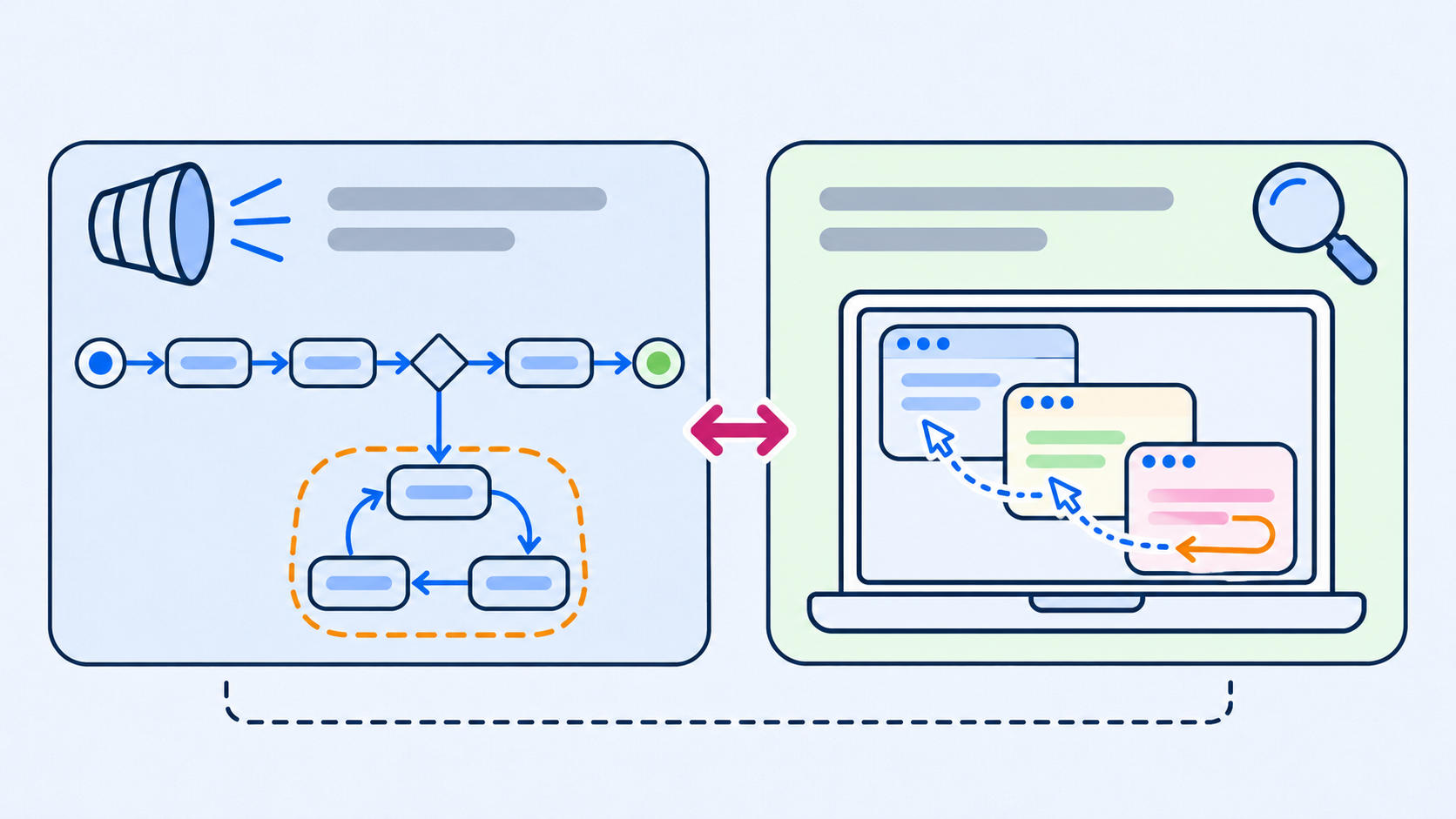
Process mining and task mining answer different questions about how work runs. Process mining reconstructs how cases move through an end-to-end process from system event data. Task mining shows how people perform specific tasks from recorded interactions across desktop applications.
The practical difference is scope. Process mining gives breadth across cases and systems. Task mining gives detail inside selected tasks. Which one fits depends on the question you need answered, the data you have, and the level of evidence the decision requires.
Process mining vs task mining at a glance
| Process mining | Task mining | |
|---|---|---|
| Focus | End-to-end flow across cases and systems | Execution inside selected tasks |
| Primary data | System events tied to cases, activities, and timestamps | Recorded user interactions during task execution |
| Typical scope | Large volumes of cases across a process | Selected tasks, users, roles, or teams |
| Questions answered | Where do cases stall, loop, deviate, or vary? | How is this task performed, and where does execution vary? |
| Strengths | Variants, bottlenecks, conformance, rework, and performance at scale | Manual steps, application switching, repeated entry, workarounds, and task variation |
| Can miss | Manual or off-system activity that is not logged or linked to the case | Unrecorded work, background system activity, and wider process context unless activity is linked to cases |
| Common uses | Process discovery, bottleneck analysis, compliance, conformance, and performance improvement | Task discovery, standardization, training, automation assessment, and usability improvement |
What process mining is good at
Process mining reconstructs the paths cases take from system event data. It is strongest for flow at scale: which variants cases follow, where they wait, where they loop back, whether they follow the intended sequence, and how performance differs across teams, regions, products, or time periods.
It works best when core systems generate usable event data with a case identifier, activity name, and timestamp, and when the question is about behavior across many cases.
Typical questions include:
Where do cases wait?
Which variants create rework?
Where do cases deviate from the expected path?
Which teams or regions perform differently?
Did a process change improve throughput or conformance?
What task mining is good at
Task mining focuses on how a task is executed across applications. Depending on the product, it may capture application changes, clicks, keystrokes, screenshots, copy-and-paste activity, or task traces.
Some tools start with a known task and compare multiple executions. Others support broader discovery across selected desktop activity.
It is strongest when the question sits inside a manual or semi-manual step.
Typical questions include:
How many steps does this task require?
Where do people switch applications or re-enter data?
How much does execution vary between users or teams?
Which actions are repetitive enough to standardize or automate?
Which task variants create extra effort or errors?
Capture depth varies widely. A task-mining product may provide anything from application-level traces to richer step and business-context data. The category label alone does not tell you what evidence you will get.
What each one can miss
Process mining can only analyze the events available to it.
A phone call, paper step, spreadsheet action, or activity in a system without usable case-linked events may be absent from the reconstruction. Missing events, inconsistent timestamps, or weak case identifiers can also make a process model look precise while leaving part of the operation outside the data.
Task mining depends on what is recorded and who is included.
Phone calls, paper, unrecorded users, devices outside scope, and background system-to-system activity can remain outside the view. Task mining also does not automatically provide an end-to-end process model. Connecting task activity to a broader process may require case identifiers or additional system data.
Because task mining observes employee activity, sampling, privacy, data handling, and review of captured activity need to be designed before recording begins.
When to use process mining
Use process mining when you need an end-to-end view across many cases, when the problem may span several steps or systems, or when you are investigating bottlenecks, variants, conformance, or throughput.
For example, a service operation wants to know why some requests take much longer than others.
Process mining can show where the additional elapsed time accumulates and which process variants are slowest.
When to use task mining
Use task mining when the problem sits inside a known task, when the work crosses several desktop applications, or when system data does not explain why execution varies.
For example, a team knows that one review step takes much longer for some people than for others.
Task mining can show whether the execution differs through application switching, repeated entry, extra navigation, or a different task sequence.
When you need both
Some questions need both levels of evidence.
Loan origination: Process mining can show that applications in one region return from review for correction materially more often than elsewhere and how that variant affects cycle time.
Task mining can then examine how correction information is assembled, which applications reviewers use, and whether the same information is entered in more than one place.
The two views narrow the investigation, but they do not prove the cause on their own. The underlying issue could still be intake quality, routing rules, interface design, training, policy interpretation, or another factor.
Mining provides evidence. Operational judgment determines the change.
Order-to-cash: Process mining can show where orders wait and which variants are slowest. Task mining can show how order entry is performed inside selected steps and whether different execution patterns are contributing to the problem.
Illustrative examples for explanation only; not based on client results.
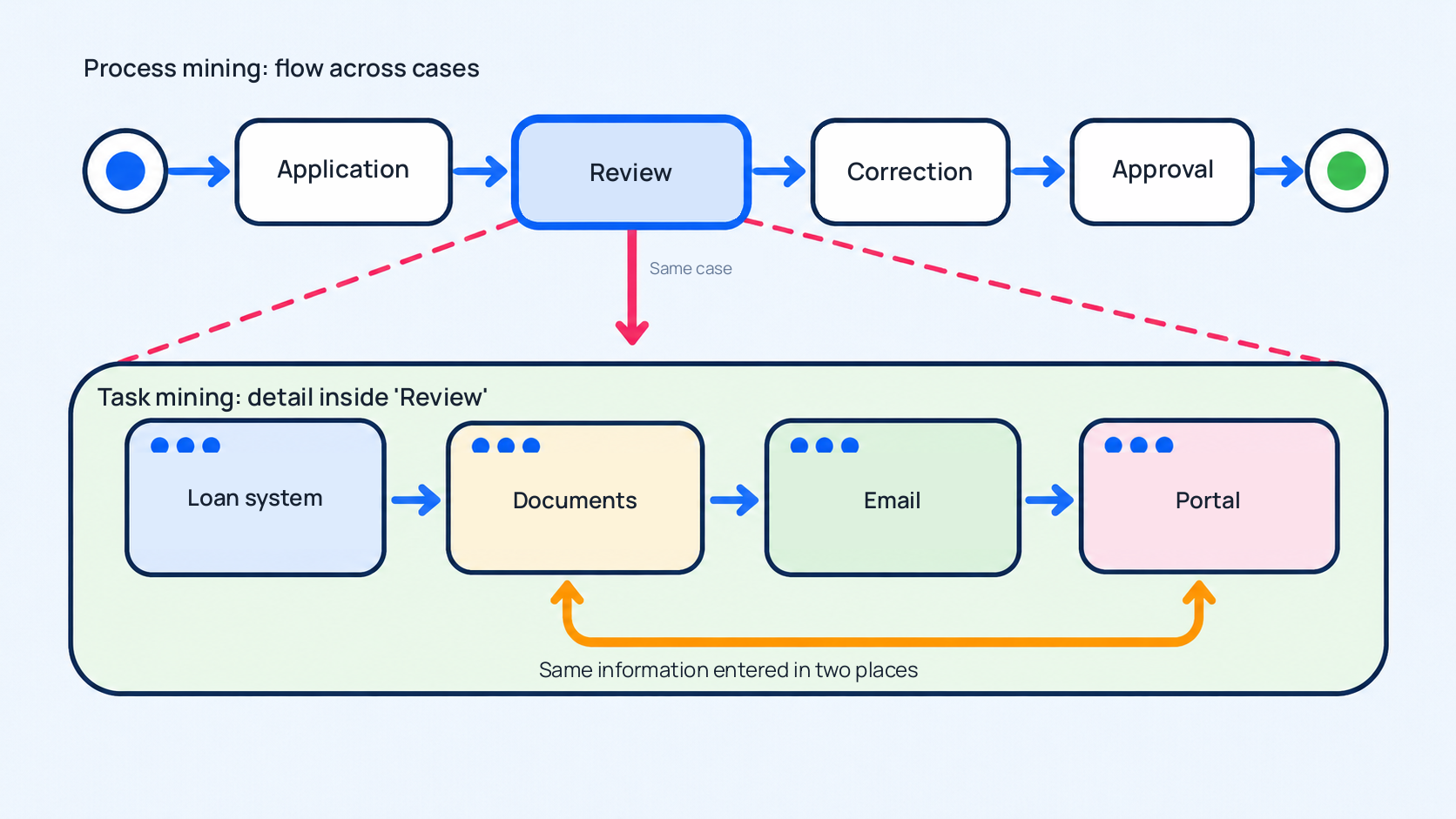
Use both when the decision depends on flow and execution together, and link the evidence to the same case where possible.
There is no universal order. Process first is common when reliable event data exists and the problem has not been localized. Task first can make sense when the problem is already a known desktop task or usable event data is weak.
What if you do not have a usable event log?
Process mining depends on usable process data. If events lack reliable case identifiers, activity names, or timestamps, the first challenge may be data preparation.
Task mining can still document how a known desktop task is performed without waiting for a full event-log project.
It does not automatically create a reliable end-to-end process model. Connecting task activity to business outcomes may still require case identifiers, additional system data, instrumentation, or another discovery method.
Where process intelligence fits
Process intelligence is used differently across the market.
It generally refers to a broader set of capabilities for understanding and improving processes, which may include process mining, conformance, analytics, simulation, task-level evidence, or AI-assisted analysis.
The useful question is what sits underneath the label: what data the product uses, what level of work it analyzes, and which decisions the evidence can support.
Task mining vs desktop analytics
Desktop analytics commonly focuses on application or device usage, such as which tools are open, how long they are used, and how often users switch between them.
Task mining is intended to show how a task is executed across steps and applications. Depending on the tool and available case linkage, it may also connect that activity to business context.
The two categories can overlap, so buyers should verify what is actually captured and how the captured activity is organized into tasks or linked to cases.
Related reading: https://stereologic.com/blog/knowing-where-the-time-went-is-not-enough
What to check in a pilot
Before committing to a method or platform, run a small pilot around a defined business question.
Is the question defined? What decision will the evidence support?
Is the required data available? For process mining, are usable case-linked events available? For task mining, can the relevant task be recorded?
Is the sample representative? Does it cover the normal range of cases, users, teams, and exceptions?
Can task activity be linked to the process or case when that connection matters?
Are privacy and governance clear? What is recorded, who is in scope, how is data handled, and how is captured activity reviewed?
If any of these is unclear, narrow the pilot until it can answer one useful question reliably.
Related reading: https://stereologic.com/blog/business-process-analysis-and-improvement-measure-before-you-change
Frequently asked questions
What is the difference between process mining and task mining?
Process mining uses system event data to show how cases move through an end-to-end process. Task mining uses recorded interaction data to show how specific tasks are performed across desktop applications.
Use process mining for process-level flow and variation. Use task mining for execution detail inside selected tasks.
Can task mining replace process mining?
Not on its own.
Task mining provides detailed evidence about task execution, while process mining provides broader context across cases and systems. Some products connect parts of both views, but the methods use different evidence and answer different questions.
Do I need both process mining and task mining?
Sometimes.
Use both when the decision needs process-level context and task-level execution detail. Either method can come first, depending on the problem and the available data.
What is process intelligence?
Process intelligence is a market term with varying definitions.
It commonly refers to a broader set of capabilities for understanding and improving processes, which may include process mining, analytics, conformance, simulation, task-level evidence, or AI-assisted analysis.
How is task mining different from desktop analytics?
Desktop analytics generally focuses on application or device usage.
Task mining focuses on how a task is executed across steps and applications. Product capabilities vary, so verify what is captured, how task traces are constructed, and whether activity can be linked to a task or case.
Find out where value is leaking out of your operation.
One agreed scope, thirty days, a measured baseline and an executive readout.