
Knowing where the time went is not enough
Where time was spent is not the same as what the operation accomplished.
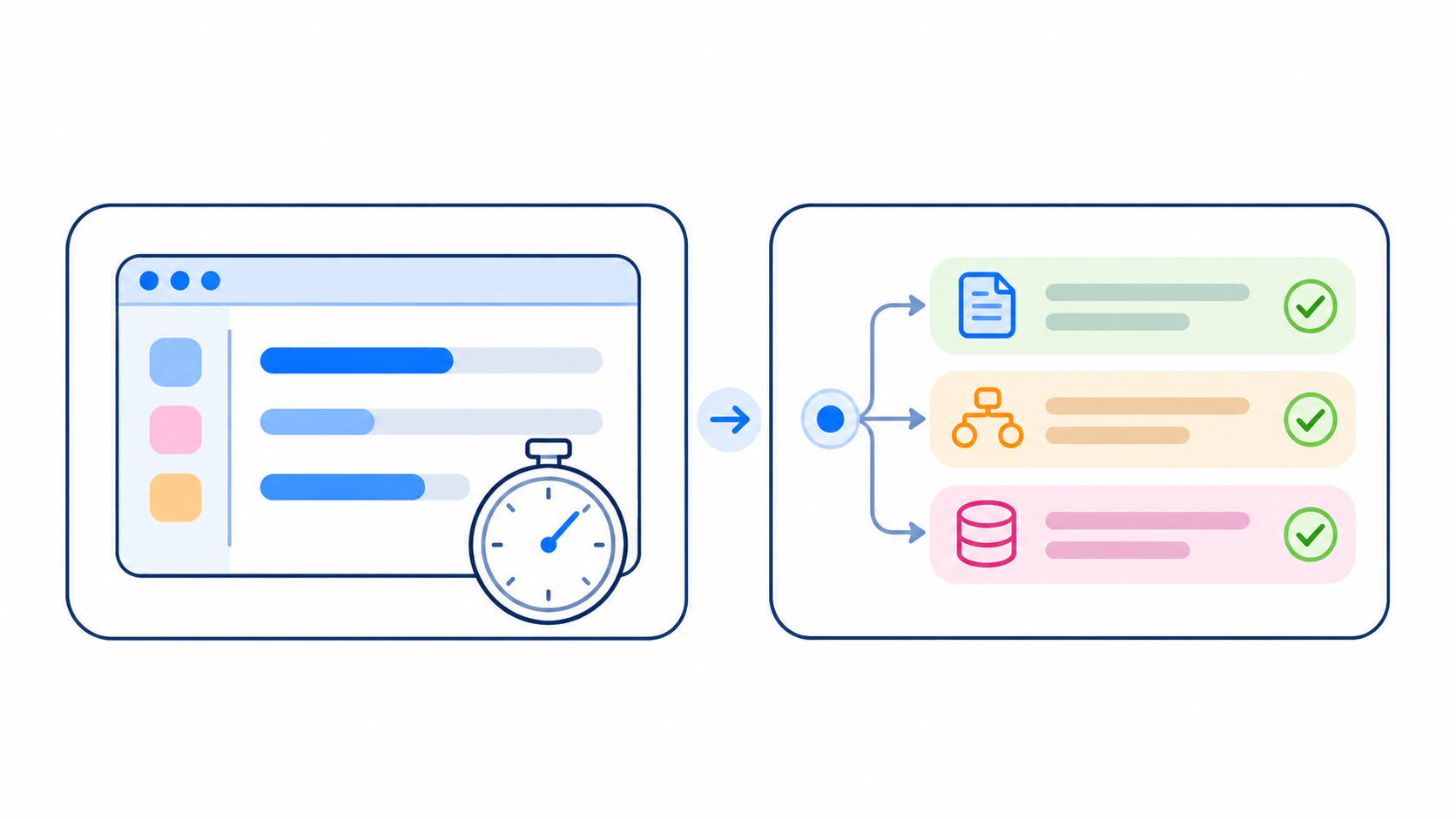
Knowing where the time went is not enough
Many enterprises are learning how Task Mining can help them understand operational work, measure the time spent on that work, and sharpen the business case for process efficiency and automation. However, many Task Mining tools only show how much time employees spend in applications and cannot precisely answer how much of that time was productive. This article explains the difference between standard Task Mining tools and Stereologic Deep Task Mining™
Application-usage analytics can answer a useful question: where was time spent?
Operations leaders are being asked a harder one: what did the operation accomplish?
Those are not interchangeable measures. Utilization can tell you that a team spent hours in a claims application. It cannot tell you how many claims were completed, which decisions were made, what came back for correction, or where work stalled.
That gap matters whenever the business case depends on throughput, capacity, quality or change.
The same afternoon, read two ways
Take an illustrative claims-processing example. One afternoon, one core application. Read the same period two ways.
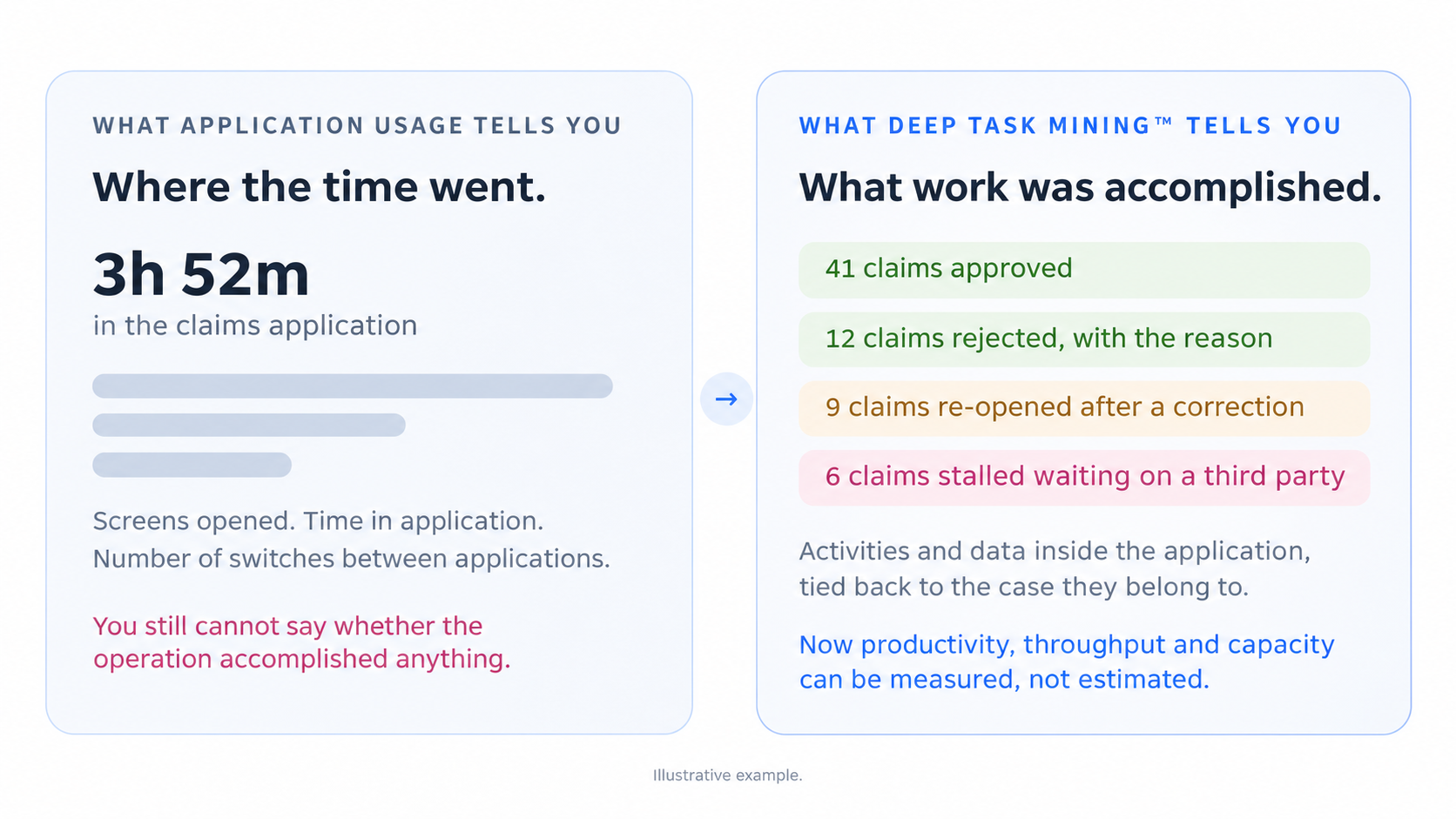
The first view can support a discussion only about the time spent. The second supports a discussion about throughput, rework, decision consistency and delay. As you can see, these two approaches can provide very different metrics and foundations for management decisions, depending on which view you have.
A busy application is not the same as a productive operation.
What turns employee activities into operational evidence
Recognizing the activity is only the first step. Connecting it to business data, decisions and cases is what turns observed activity into countable work. That distinction matters beyond analytics.
When an operations leader takes a throughput number to Finance, or a transformation team uses it to size an automation opportunity, the evidence has to survive the obvious question: how do you know?
A reviewable chain from observed work to business outcome is what makes the answer defensible.
What it changes downstream
Once work is measured at the level of cases and outcomes rather than windows and clicks, the management questions become much more useful:
Which teams are completing more work, and what actually differs in how they do it?
Where do decisions vary between people handling the same kind of case, and is that variation justified?
How much of the operation's capacity is being consumed by rework, repeat handling or unnecessary switching?
Which delays are active work, which are waiting, and which sit outside the team's control?
Each answer points to a different intervention.
More importantly, each can be measured again on the same terms after the change. That is how an improvement moves from a plausible story to a result the business can defend.
The honest limit
Evidence at work level is not automatic truth.
It only sees what is observed, so phone calls, paper and unobserved work can remain outside the picture. Recognition can be wrong and needs review. Sampling matters.
Task-level evidence also does not replace every other source of process evidence. Where usable event logs exist, Process Mining can extend the system-recorded layer; where employee work lives inside applications, task-level evidence fills a different gap.
The goal is not to force every question through one technology label. It is to use the evidence that answers the business question, and to be explicit about what it cannot see.
Where this goes next
Stereologic Deep Task Mining™ connects observed work inside applications to business data, decisions and cases, then ties that task-level evidence into the end-to-end operation. The principle is broader than any one platform: if the business needs to improve throughput, measure the work, not the window.
Find out where value is leaking out of your operation.
One agreed scope, thirty days, a measured baseline and an executive readout.